Stage 3: What evidence proves that a yacht fits your family?
Check the actual party against the actual yacht—not length, photographs or a generic “family-friendly” label.
- No: obtain the applicable permission rather than inferring it from beds.
- Vehicle → quay → boarding equipment → cabin → bathroom → dining area → shaded outside space → emergency arrangements → tender, if required.
Which documents should you request?
MYBA’s published broker and charter-manager guidance identifies registry documents, vessel insurance and liability coverage, powers of attorney where necessary, crew profiles and other relevant certificates as documents managers should provide to retail brokers on request. Use that as a starting point, while asking qualified reviewers which certificates apply to the particular yacht. (myba-association.com)
Build the following buyer evidence index:
| Evidence | What you are trying to establish | Who should answer |
|---|---|---|
| Yacht identity and registry | Correct vessel, flag and registered identity; official or IMO number where applicable | Charter manager |
| Contracting authority | Connection between the yacht, owner/contracting entity and authorised signatory | Manager and lawyer |
| Commercial and local permissions | Whether this yacht can perform this proposed charter | Manager, local agent and relevant specialist |
| Passenger certification | Permitted numbers for the operation proposed | Manager; flag/competent authority where necessary |
| Insurance confirmation | Dates, charter use, cruising area and relevant activities | Manager and insurance adviser |
| General arrangement and cabin schedule | Beds, locations, bathrooms and family allocation | Manager and captain |
| Current crew information | Expected captain, chef and service team; known substitutions | Manager and captain |
| Current equipment list | Essential amenities, tenders and toys, including restrictions | Captain |
| Accessibility walkthrough | Continuous route through the spaces the guest must use | Captain and appropriate access adviser |
| Operating estimate | Route-dependent fuel, berthing and other expenses | Captain and local agent |
A buyer is collecting evidence, not personally certifying seaworthiness. Where documents cannot be distributed freely, ask whether a qualified adviser can inspect them and provide a scoped written confirmation.
Does “sleeps 12” mean 12 people can legally charter?
No: obtain the applicable permission rather than inferring it from beds. The Red Ensign Group framework distinguishes Part A yachts carrying no more than 12 passengers from Part B passenger yachts carrying more than 12 and no more than 36. That is an example of a regulatory framework—not a universal permission for every yacht or every country. (gov.uk)
List everyone travelling. Ask specifically how children, a nanny, household employees and additional visitors are treated under the yacht’s permissions and agreement. Do not designate someone “crew” yourself to make the numbers work.
For US operations, do not import a Mediterranean guest-limit assumption. The US Coast Guard has terminated unlawful charters and advises passengers to check operator credentials and applicable inspection documentation. Refer a yacht-specific uncertainty to the relevant Coast Guard sector or maritime adviser rather than applying a blanket six- or twelve-person rule yourself. (news.uscg.mil)
How do you test cabin fairness?
For an illustrative party of three couples and four children, start with this allocation:
| Guests | Proposed accommodation | Question to resolve |
|---|---|---|
| Couple A | Main-deck double | Is this allocated for access needs or principal preference? |
| Couple B | VIP double | Are bed dimensions and bathroom acceptable? |
| Couple C | Third double | Is the difference in size/privacy acceptable? |
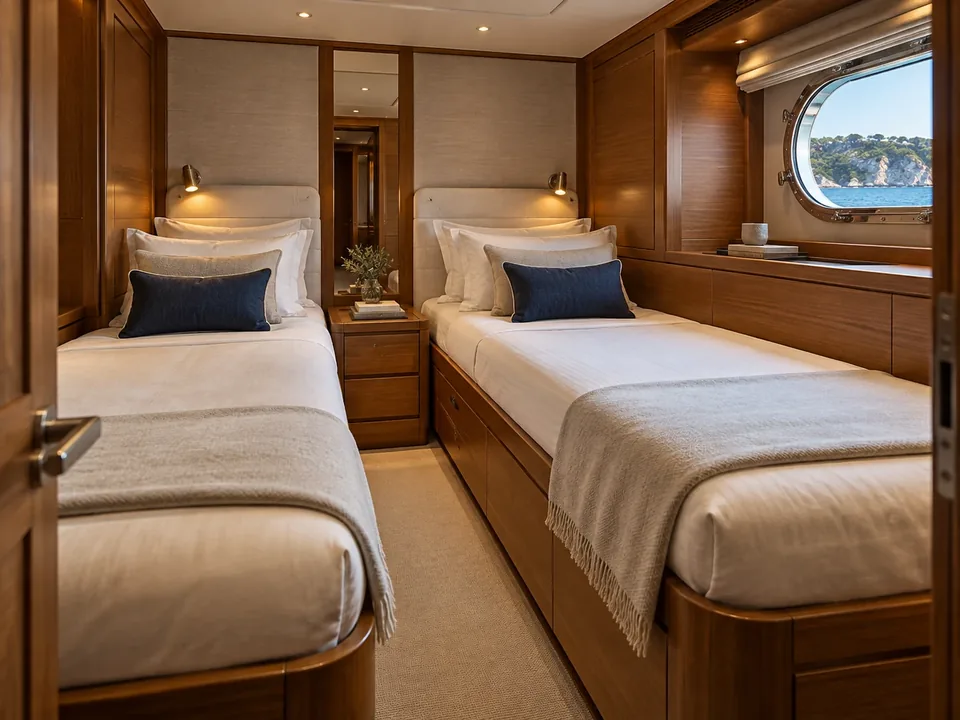
| Children 1 and 2 | Twin cabin | Are these actual separate beds, and where are the parents? |
| Children 3 and 4 | Twin cabin | Is age-appropriate sharing agreed? |
| Additional nanny, if required | Not yet allocated | What berth and passenger permission will be needed? |
Do not approve “five cabins” without completing the allocation. Confirm convertible beds, supplementary berths and any restrictions explicitly.
What does wheelchair-accessible yacht charter due diligence require?
Treat “wheelchair access” as the start of a conversation. Fraser’s accessibility material identifies features such as wider boarding arrangements, lifts, stair lifts and adapted bathrooms, illustrating why a single amenity does not describe the entire journey. (fraseryachts.com)
Request a live or recent walkthrough following this route:
Vehicle → quay → boarding equipment → cabin → bathroom → dining area → shaded outside space → emergency arrangements → tender, if required.
Ask for dimensions, thresholds, lift coverage, transfer requirements and the assistance available. Include expected marina and tide conditions in the discussion. A guest’s own functional requirements should determine the acceptance criteria.
How do you check crew, children’s arrangements and essential equipment?
Ask for the crew expected on your dates, their relevant experience and any known changes. Request recent comparable references through an appropriate, privacy-respecting process—not private guest contact details without consent.
Burgess explicitly cautions that entertaining children is not the crew’s primary role and discusses bringing a nanny. Agree adult supervision and childcare arrangements instead of treating a friendly crew as a childcare service. (burgessyachts.com)
For equipment, request separate answers about stabilisation at anchor and underway, boarding aids, tender seating, toy operation and internet performance. Northrop & Johnson warns that equipment can change, personal watercraft may face restrictions or licensing requirements, and connectivity is not guaranteed. Essential requirements belong in the pre-contract discussion. (northropandjohnson.com)
Recruitment sites such as Yotspot can provide industry context, but an anonymous vacancy is not reliable evidence that a particular shortlisted yacht is losing its captain or chef. Do not turn a possible match into an allegation. (yotspot.com)
How should evidence be scored?
Keep suitability and evidence strength in separate columns:
- Documented: relevant document inspected; date and issuer recorded.
- Supplier-stated: named counterparty supplied a dated answer.
- Estimated: an assumption or calculation with inputs shown.
- Not established: evidence missing, inconsistent or insufficient.
A supplier-stated claim is not automatically false. It simply has a different evidential status from a checked document.
Output: a family-fit assessment and evidence register for each finalist.
Do not proceed if: a non-negotiable depends on an unsupported assumption.
Sources cited
- myba-association.com https://www.myba-association.com/files/index.cfm?crypt=295805&id=1127
- gov.uk https://www.gov.uk/government/publications/msn-1895-m-the-red-ensign-group-reg-yacht-code-part-a/msn-1895-m-the-red-ensign-group-reg-yacht-code-part-a
- news.uscg.mil https://www.news.uscg.mil/Press-Releases/Article/3844349/coast-guard-terminates-voyages-of-two-illegal-charter-vessels/?utm_source=openai
- fraseryachts.com https://www.fraseryachts.com/en/superyachts-for-charter/with-wheelchair-access/?utm_source=openai
- burgessyachts.com https://www.burgessyachts.com/en/editorial/news/family-friendly-charters?utm_source=openai
- northropandjohnson.com https://www.northropandjohnson.com/charter-terms-and-conditions?utm_source=openai
- yotspot.com https://www.yotspot.com/?utm_source=openai