Stage 3: How do you establish whether the yacht actually fits?
Test the proposed yacht against a normal day for your actual guests: boarding, sleeping, eating, moving between decks and going ashore. Treat dimensions and arrangements as questions to verify, not impressions to infer from photographs.
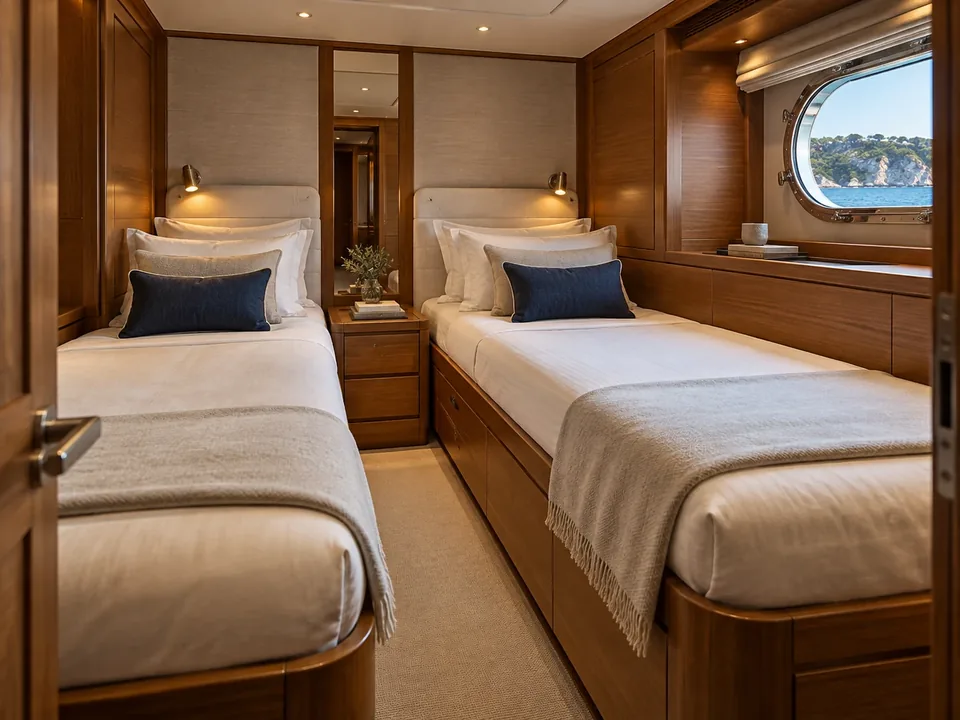
- Illustrative cabin test:
- Request documentary support for the proposed passenger arrangement. Do not use berth count as the approval test.
Checklist: family fit, cabins and accessibility
- Allocate every guest to a specific cabin and bed.
- Confirm which beds convert, their resulting dimensions, and any restrictions on additional berths.
- Identify stairs between bedrooms, dining areas, outdoor seating and boarding points.
- For mobility needs, request measurements and a current walkthrough of the complete route—not merely confirmation that an elevator exists.
- Check bathroom access, thresholds, turning space, boarding equipment and tender transfers.
- Agree the childcare arrangement and identify the responsible adults.
- Confirm dietary requirements directly with the operational team; escalate significant medical requirements to the guest’s clinician and appropriate travel specialist.
- Request confirmation of the required stabilization modes, shaded areas, swimming access and essential equipment.
Northrop & Johnson’s accessibility guidance identifies doorways, passages, bathrooms, lifts and boarding access as relevant features. Burgess separately cautions that entertaining children is not the crew’s primary role. Those are reasons to ask specific questions rather than accept “accessible” or “family-friendly” as sufficient answers. (northropandjohnson.com)
Illustrative cabin test: three couples wanting double beds and four children sharing in pairs need three suitable double cabins and two suitable twin cabins. Adding a nanny requires a fresh allocation; it is not solved by retaining the original guest count in the enquiry.
How should you verify passenger permissions?
Request documentary support for the proposed passenger arrangement. Do not use berth count as the approval test. For example, the UK Maritime and Coastguard Agency’s REG Yacht Code guidance distinguishes Part A yachts carrying no more than 12 passengers from vessels covered by Part B. That is a specific regulatory framework, not a universal worldwide permission for every yacht to carry 12 guests. (gov.uk)
For a US operation, ask the broker or qualified maritime adviser to identify the applicable operating structure and supporting credentials. The US Coast Guard advises paying passengers to check operator credentials and applicable vessel inspection documentation. Do not import a Mediterranean assumption into a US charter. (news.uscg.mil)
Include children and accompanying household staff in the proposed manifest and ask the operator to explain their treatment. Refer unresolved capacity questions to a qualified adviser before selection.
Is the Bahamas or Caribbean itinerary realistic?
Ask the captain to review a leg-by-leg plan with:
- Expected departure and arrival times.
- Cruising speed and time underway.
- Fuel assumptions, including generators, tenders and any chase boat.
- Draft, anchoring, tender-access and shore-transfer limitations.
- Weather alternatives and the return route to the disembarkation point.
As a useful illustration of why this matters, Fraser’s published eight-day Bahamas itinerary lists 279 nautical miles and 20 hours 20 minutes of cruising. Those are itinerary estimates, not a promise for your chosen yacht or conditions. Ask how much of your own vacation would be spent moving rather than enjoying each stop. (fraseryachts.com)
For Atlantic, Caribbean and Bahamas planning, the official Atlantic hurricane season runs June 1–November 30, and activity can occur outside it. Use this as a planning consideration, not a forecast for a particular week. (nhc.noaa.gov)
Stage output: a workable cabin plan and captain-reviewed route, with unresolved access or operating questions clearly flagged.
Sources cited
- northropandjohnson.com https://www.northropandjohnson.com/yachts-for-charter/wheelchair-accessible
- gov.uk https://www.gov.uk/government/publications/msn-1895-m-the-red-ensign-group-reg-yacht-code-part-a/msn-1895-m-the-red-ensign-group-reg-yacht-code-part-a?utm_source=openai
- news.uscg.mil https://www.news.uscg.mil/Press-Releases/Article/3844349/coast-guard-terminates-voyages-of-two-illegal-charter-vessels/?utm_source=openai
- fraseryachts.com https://www.fraseryachts.com/en/itinerary/bahamas/?utm_source=openai
- nhc.noaa.gov https://www.nhc.noaa.gov/climo/?utm_source=openai